
Stories of God at Work in Harvest Times
By Deacon Tuttle
This year, our church network has begun placing a weekly emphasis on evangelism. Born out of a conviction from Jesus’ own words, “The harvest is plentiful, but the workers are few” (Matthew 9:37-38), it’s a boots-on-the-ground call to share God's mission. The Lord is able to use us exactly where we are—equipping us, emboldening us, and reminding us that the Gospel is an invitation extended to all.
Every Tuesday and Thursday, we’ve begun creating space for students and staff who want to live missionally toward unbelievers—praying specifically for conversations that lead to life change and surrender through the life, death, and resurrection of Jesus. Holy Week offered a unique opportunity. As we tabled on campus and initiated conversations, we found that people from all different walks of life were unusually open to reflecting on spiritual themes. Questions like, “Who is Jesus to you?” “What’s the purpose of Easter?” “Where do you place your hope?” created natural and meaningful pathways to the Gospel and deeper conversations about God’s character.
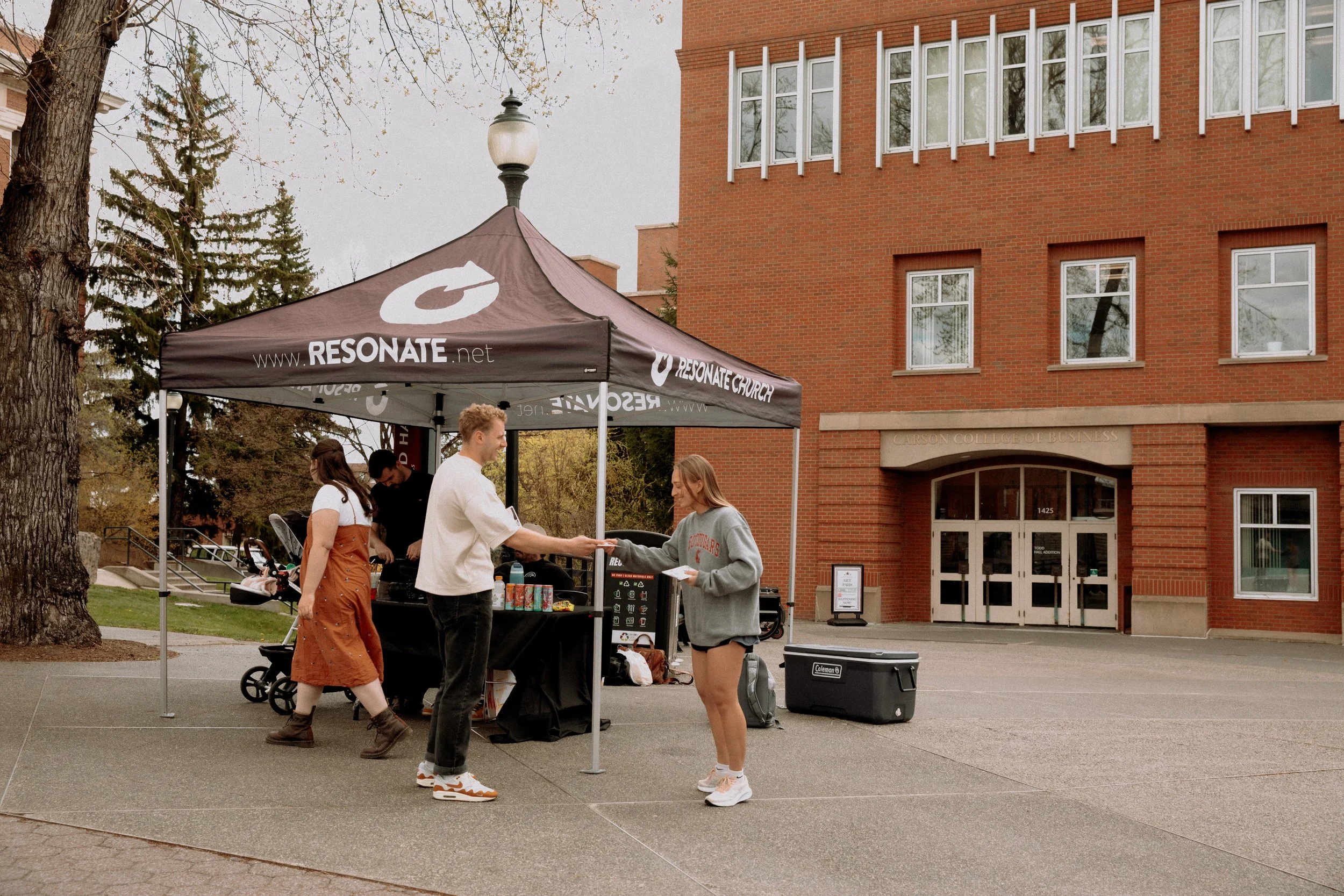
Questions like, “Who is Jesus to you?” “What’s the purpose of Easter?” “Where do you place your hope?” created natural and meaningful pathways to the Gospel and deeper conversations about God’s character.
In just one week at CWU, our team was able to share the Gospel personally with students 31 times.
I was able to observe our local staff team in Ellensburg tabling as we harvested during Holy Week. It was a fruitful assortment of conversations that ranged from simple inquiries, such as “Would you like an energy drink?” to deep explorations about the nature of faith and the resurrection of Jesus. The conversation that struck me most because of its honesty, , was between campus intern, Aleigha, and a student she met on April 15th.
The student expressed her belief in mythology more than in organized religious structures. Amid her explanation, the topic of the Greek understanding of Hades came up. After Aleigha shared the Gospel, which was the first time the student had heard it, Aleigha then asked her, “Do you think you’re going to Hell?” The student believed she would, and she might be ok with that reality.
This was shocking to Aleigha during the conversation itself, and upon reflection, Aleigha told the student the truth that God has made a way for eternal life and for humans not to perish in Hell. From my perspective, I saw the student as open, curious, saddened, and longing. She did not decide to follow the Lord that day, but Aleigha was faithful to share the hope of the Gospel and tell her that God desires a relationship with her.
While I was observing, I was drawn into a conversation that was both swift and unexpected. I met an underclassman who will be referred to as Alan. We began our conversation after he answered the question, “What do you have hope in?” His response was, “I have hope in the future, my plans turning out.” To which I responded, “What happens if/when those don’t happen?”
Alan seemed to appreciate my bluntness, and I quickly realized he had had these sorts of conversations before. Alan had come from a Latter-day Saints background. Once he was able to move on from those beliefs and that church system, he did so. He now considers himself an agnostic. Even with his poor experiences growing up, Alan remains open to believing in God, but expressed that he needed more explicit proof. This was exciting for me. I’m incredibly passionate about apologetics and asked if he was familiar with it. He told me he wasn’t sure what that was and was kind enough to allow me to elaborate. We discussed objective versus subjective morality, the historical evidence for the resurrection, the reliability of New Testament manuscripts, and the classic question posed by C.S. Lewis – whether Jesus was a liar, a lunatic, or the Lord.

We discussed objective versus subjective morality, the historical evidence for the resurrection, the reliability of New Testament manuscripts, and the classic question posed by C.S. Lewis – whether Jesus was a liar, a lunatic, or the Lord.
This was a 45-minute discussion, and it was life-giving to me. It was refreshing to encounter someone willing to challenge but also receive correction when he misquoted or misstated facts. There was a mutual bond between our desires to know the truth, and I encouraged him that as he truly seeks Jesus, the truth will be made known to him (Matthew 7:7-8).
Alan was honest about how his hesitation to believe might be connected to his experience in the LDS church —specifically, the pressure to obey and the feeling that his worth was diminished when he didn’t measure up. At one point he told me, “I never felt like I was enough.”
I told him that saddened me—and that the LDS church’s theology had painted an incorrect picture of God's nature and His commands. Because of their excessive rules and tiered systems of merit, he was left with the impression that God's love had to be earned. But the true Jesus came to carry our burdens for us, not to place heavier ones on our shoulders. I shared how Jesus invites us to take on His yoke, and that it is easy and light (Matthew 11:28-30)—not something meant to crush us or leave us constantly feeling like we’ll never satisfy God.
And yet, even with all that pain, he told me he’s interested in raising his kids generally Christian, for the foundation and the “righteous” aspects of it. I challenged him that if he would consider the morality of it and of Jesus, why not go to the full extent and trust that Jesus also made claims about His supremacy and Lordship. I got his number, and he even expressed interest in going to a Christian church for the first time.
“In these conversations, God reminded me that there are always people around us who are willing to engage in spiritual discussions—sometimes even hungry for them.”
In these conversations, God reminded me that there are always people around us who are willing to engage in spiritual discussions—sometimes even hungry for them. God stirred my heart in both moments: I was moved with emotion, sharing the love of Jesus with Ian, and heartbroken as I listened to A’s story of feeling crushed by a distorted view of God’s expectations.
But through it all, I was honored. It is a true privilege to carry the message of Jesus wherever we go. Even in times when we feel lazy, distracted, or timid—if we submit and trust God with boldness, He is faithful to use those moments for His glory and to shape us in the process. There are times when it may seem difficult or intimidating to go share the Gospel. However, when we ponder God’s love for us and the gift of the Gospel, as well as reflect on those who brought the message to us, we can gain the perspective that we have the opportunity to do so for others who are right next to us on our campuses.